A Daily Planner, Daily Schedule Isn’t the Problem — Your Approach Probably Is
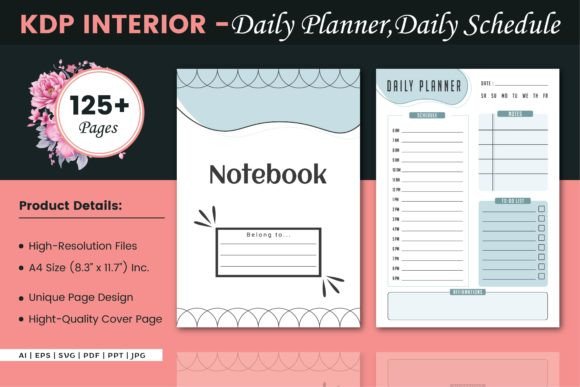
There’s a quiet frustration that settles in when a fresh planner stays blank past the first week. You download a beautiful set of Daily Planner, Daily Schedule templates, maybe from a KDP interior pack, and you feel that surge of motivation. The pages are crisp, the layout seems right, and the 125-page A4 document looks professional. Then you hit “print” or upload to Amazon, and the finished product never quite delivers what you imagined. The issue rarely lies with the templates themselves — it’s how they’re chosen, adapted, and used that determines whether someone’s planning habit sticks or falls apart.
With a resource that includes 100 ready-to-upload interiors, editable vector files in AI, EPS, and SVG, plus multiple format types like PDF and PPT, you have more than enough raw material. But that abundance can also become a trap. The real skill lies in knowing what to avoid before you ever bind a page or list a journal for sale.
The Hour-by-Hour Mirage That Derails Your Day
One of the most common mistakes people make when picking a Daily Schedule layout is defaulting to an hourly breakdown from 5:00 AM to 9:00 PM. It looks disciplined. In practice, it teaches most users to ignore the planner entirely. Life doesn’t fit neatly into 60-minute boxes. A creative professional juggling client calls, unexpected revisions, and deep work will ignore those time slots after the first interruption. A small business owner who shifts between marketing, fulfilment, and customer questions will simply scribble outside the lines, then feel like they “failed” the system.
When you’re browsing a collection of 100 templates, resist the pull of a rigid hourly grid unless you genuinely live by the clock. Instead, look for layouts that prioritize task blocks, outcome-focused sections, or simple morning/afternoon/evening dividers. The good news is that having editable source files — especially the AI, EPS, and SVG formats — lets you gently modify an hourly template into something looser. You can delete time stamps, replace them with priority lanes, or widen sections for uncategorized work. A Daily Planner should reflect your real rhythm, not an idealized version of it.
When Too Many Sections Sink Your Focus
Another well-intentioned misstep is cramming the page with too many specialist zones. Gratitude prompts, water intake trackers, meal logs, top three goals, affirmations, and an hourly breakdown all on one spread feel comprehensive. They actually create decision fatigue. A user stares at the page, unsure where to start, and the empty planner becomes a quiet source of guilt.
KDP interior designers sometimes chase market appeal by packing in features, but the bestsellers often do the opposite. They clear mental space. If you’re building a planner for yourself or for customers, open the PDF or PPT file and start removing non-essential boxes. The 125-page structure gives you enough length to spread specialized tracking across different weeks, or turn some pages into dedicated reflection inserts rather than daily cluttering. Remember that an A4 page with no bleed leaves plenty of white margin; you don’t need to fill all of it. A single strong Daily Schedule section — like a timeline with only three pulse points — can anchor the entire day better than a dozen scattered to-do boxes.
Neglecting the Physical Experience of the Book
A digital template looks flawless on screen. When it becomes a physical notebook, small oversights start to hurt usability. People often print 125 pages on thin 80gsm paper, bind it with a tight spine that refuses to lay flat, and then blame the planner for being uncomfortable. Since this product pack includes a no-bleed A4 format, you won’t have to worry about trim issues, but you absolutely need to think about thickness, binding type, and paper quality.
If you’re preparing a KDP upload, do a test print of a few interior pages using the high-resolution PDF. Try writing on them with a gel pen, a fountain pen, and a pencil. Check whether the line spacing is actually comfortable for your handwriting size, not just what looked proportional on screen. The JPG previews or the PPT slides can give a sense of layout, but only a physical sample reveals if a Daily Planner, Daily Schedule page becomes cramped during real use. Adjust the design in Illustrator or Inkscape using the SVG file to increase line height or widen gutters. These tiny tweaks separate a journal that gets used from one that gets abandoned.
Skipping the Test Run Before Bulk Printing or Publishing
With 100 ready interiors at your disposal, the temptation to upload everything immediately is strong. Many first-time KDP creators do exactly that. They don’t print even a single week to road-test the flow. The result is often a 1-star review pointing out something obvious that would have surfaced in a three-day trial.
A smarter path is to take one template out of the pack — maybe the simplest Daily Schedule option — and use it personally for five consecutive days. Mark it up. See where you accidentally squash tasks into the margins. Notice whether the priority section gets ignored while a makeshift “today’s wins” box in the corner gets all the attention. Then go back to the editable source file and move sections accordingly. The PPT format is surprisingly useful here for quick layout experiments without touching vector nodes. Even swapping the order of two boxes can dramatically improve the page’s logic. This small investment of time pays back enormously in customer satisfaction and repeat interest.
Forgetting That a Planner Is a Personal Interface, Not a Fixed Product
Marketers and bloggers often treat a Daily Planner as a finished item. It’s not. It’s an interface between someone’s intentions and their time. The best planners feel like they were built for one specific person — not for a vague audience. When you have fully editable AI and EPS files, the cost of personalization is almost zero. Yet so many skip it, leaving generic headers like “Today’s Tasks” and “Notes” that could belong to any journal. Adding context-specific labels — say, “Client Follow-ups” for a freelancer, or “Class Prep” for an educator — instantly makes the page feel tailor-made.
Don’t underestimate the cover either. The pack includes an extra cover page, which is a chance to signal exactly who the journal serves. A minimalist geometric cover might appeal to architects, while a soft watercolor might speak to wellness coaches. Align the interior’s language with the cover’s promise. If the first page inside is a cold, faceless grid after a warm, inviting cover, the disconnect jars. Use the included vector files to carry design motifs from the cover into section dividers — even a small repeated icon can create a cohesive experience that boosts perceived quality.
Relying on One Format When Multiple Are at Your Fingertips
Not everyone edits graphics the same way. Some users are comfortable in Adobe Illustrator, others freeze the moment they see bezier curves. The pack thoughtfully provides AI, EPS, SVG, PDF, PPT, and JPG options. A common frustration occurs when someone tries to force an AI file open in a program that doesn’t support it, then concludes the product is broken. The PPT version, on the other hand, opens in PowerPoint, Google Slides, or LibreOffice, allowing simple text edits and layout shifts without any design skills. Before you start customizing, check which format fits your current software reality. For quick print-at-home setups, the PDF is often enough. For heavy customization, SVG or AI gives full control. Match the tool to your comfort level rather than struggling uphill with a wrong file type.
Treating the 100 Templates as a Finished Collection Instead of Raw Ingredients
Perhaps the biggest missed opportunity is viewing the pack as “done.” A creator might pick one template, duplicate it 125 times, and call it a day. But what if the planner mixed a few different layouts? A weekly overview followed by five daily spreads, then a blank notes page, creates a rhythm. It’s like a well-structured playlist — no single song feels like a marathon. With 100 starting points, you can string together a sequence that keeps the user engaged. Monday could have a more detailed Daily Schedule with meeting slots, while Friday’s page could lean into reflection and loose planning. Remix, don’t just duplicate. The editable nature of the files makes this stitching seamless.
It’s also worth remembering that a planner used by real people picks up personality. If you’re selling these on KDP, consider leaving deliberate breathing room for decoration, stickers, or color coding. A page that feels too complete discourages interaction. A page with intentional gaps invites the user to participate, and that tiny shift in engagement often leads to a full planner and a positive review.
Ultimately, the value of a Daily Planner, Daily Schedule template bundle doesn’t sit in the number of pages or the variety of file formats. It sits in how thoughtfully you bridge the gap between a generic layout and a lived day. Every blank space is a cue. The question is whether that cue pulls someone toward clarity or adds to the noise. With a bit of editing discipline, honest testing, and a focus on the actual person who will hold the finished notebook, you turn a simple interior pack into a tool that actually shapes attention — and that’s something people keep coming back to.