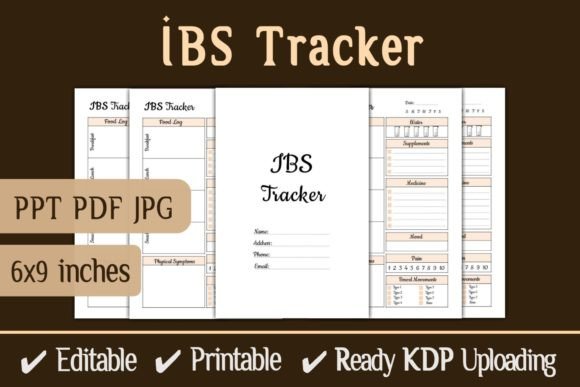
IBS Tracker Log KDP Interior Template: A Practical Workflow for Publishing a Useful Health Journal
Creating a low-content book that actually helps people requires more than a good idea. It demands a repeatable process, clean design, and an interior that handles the daily reality of symptom logging without overwhelming the user. The IBS Tracker Log KDP Interior Template exists to bridge that gap—it gives you a ready-to-upload, fully editable foundation that turns a complex tracking need into a structured, printable book. For publishers, coaches, nutritionists, bloggers, or anyone building a product line around digestive health, this template removes the friction of layout design and lets you focus on what the end user needs: clarity, consistency, and a journal that actually gets used.
This isn't just a PDF. You receive an editable PowerPoint file, a print-ready PDF, and JPG previews—all sized at 6×9 inches with 110 pages and a no-bleed interior. That combination means you can personalize content, adjust sections, or even rebrand the tracker to fit a complementary product suite. Whether you’re publishing on Amazon KDP, using it as a lead magnet for a health coaching practice, or printing physical copies for clients, the template functions as a plug-in component inside a larger publishing or patient-support workflow.
Where an IBS Tracker Fits into a Broader Health Publishing Plan
Digestive health tracking sits at the intersection of functional medicine, self-care, and habit-building. The IBS Tracker Log book KDP Interior Template download gives you a complete interior that aligns with the way people actually manage irritable bowel syndrome: through daily observation of triggers, meals, stress levels, bowel patterns, and symptom severity. For a publisher or creator, this isn't a standalone novelty item. It belongs inside a catalog that might include meal planners, elimination diet journals, pain trackers, or wellness notebooks. Releasing a dedicated IBS log strengthens your brand's authority in a niche that values credibility and usefulness over decoration.
When you map out a product launch sequence, consider where this tracker lands in a customer’s journey. A nutrition blogger might offer a free 7-day symptom snapshot as a list-building incentive, then upsell a full 110-page printed journal. A KDP publisher might bundle the IBS tracker with a low-FODMAP cookbook interior, creating a two-product funnel. A health coach might print bound copies to hand out during initial consultations, using the journal as both a diagnostic tool and a retention mechanism. The editable PowerPoint file makes these variations possible without restarting from scratch.
From Blank Slide to Print-Ready Interior: Working with the Editable PPT File
The inclusion of a full-editing PowerPoint file changes the production timeline dramatically. Instead of commissioning a designer or wrestling with design software, you open the PPT, assess the layout, and make targeted adjustments. If you want to add a logo, modify section headings, insert a dedicated “water intake” log, or include brief educational tips at the bottom of each page, you can do that in minutes. The template’s structure acts as a scaffold—the page count, margins, and no-bleed trim are already set, so you can edit without worrying about breaking KDP’s formatting requirements.
Here’s a practical sequence for adapting the template before upload:
- Open the PPT file and do a quick audit of all 110 pages. Identify any placeholder text that needs replacing or any trackers you want to rename for your audience (e.g., “Bristol Stool Chart” to “Digestive Output Log”).
- Insert your branding elements—website URL, a brief introduction page, or a “How to Use This Journal” guide—keeping the no-bleed safety zone intact.
- Export a test PDF and review it in a PDF viewer at 100% scale. Check contrast, font readability, and alignment consistency across spreads.
- Use the JPG files to mock up a product listing image on Amazon or to share previews on social media before the launch.
Because the template is 6×9 inches, it matches the most common trim size for low-content books, which simplifies paperback creation in KDP’s cover calculator. No-bleed interiors also reduce manufacturing issues—pages can be printed without needing ink to extend past the trim edge, so Amazon’s print-on-demand machinery handles them reliably.
Integrating the IBS Tracker with Other Tools, Resources, and Client Systems
A standalone journal works, but its value multiplies when it connects to something else. If you’re a functional medicine practitioner, you probably already use intake forms, symptom questionnaires, and patient education handouts. The IBS Tracker Log KDP Interior Template becomes a physical counterpart to those digital tools. Patients can fill out paper logs between appointments, and the consistency of the format makes it easier for you to spot patterns during follow-ups. You might even design the tracker’s fields to mirror the data points you already collect in your EHR, so moving from paper to digital note is straightforward.
For creators selling on KDP, think about how this interior can cross-pollinate with other products. Link the IBS tracker to a companion recipe book by using matching heading styles or a shared color palette across your covers. Set up an email automation that delivers a digital version of the tracker when someone buys your online course about gut health. The PowerPoint file lets you extract individual pages—maybe a weekly summary sheet or a trigger-food log—to use as standalone printables on a membership site. This turns one template into a content engine that feeds multiple channels.
Maintaining Quality Control, Consistency, and Long-Term Value
Low-content books live or die by their interior usability. A tracker that feels repetitive, cramped, or unhelpfully generic will get abandoned. When you work from this template, pay attention to the density of information per page. The 110-page count gives enough room to avoid squeezing too many tracking fields onto one sheet. Test your edited version by printing a few pages at home. Write in the blanks as a real user would. Does the line spacing allow for legible handwriting? Are the time slots for meal tracking realistic? Is there space to note additional variables like sleep quality or medication timing? Small adjustments here—maybe adding a “notes” line or widening a column—can turn a frustrating form into a daily habit.
Consistency across the book matters for repeat customers. If you publish a series—IBS tracker, migraine tracker, chronic pain tracker—use this template as a base design system. Keep typefaces, grid structures, and section logic consistent so your catalog feels cohesive. The editable PPT makes that manageable; you can duplicate the master file and tweak content without redesigning the entire grid. For quality assurance, always preview the final PDF on multiple devices. Open it on a tablet to see how it reads digitally, and print a sample through KDP’s proof ordering system to check physical page turns, paper weight feel, and binding margins.
Implementation Scenarios for Different Roles
How you deploy the IBS Tracker depends on your role and your audience’s context. Here are a few real-world examples:
KDP Publisher Expanding a Health Niche: You already have a few recipe books or workout journals. Adding an IBS log widens your demographic to include people with chronic conditions who need daily documentation tools. Use keyword research to identify related search terms (symptom diary, digestive health journal, gut health tracker) and optimize your Amazon listing title and bullet points naturally. Mention that the interior is professionally designed with 110 pages, 6×9 inches, no bleed—details that reduce buyer hesitation.
Registered Dietitian or Health Coach: Instead of selling the journal on Amazon, you order author copies and hand them out as part of a paid program. The editable file allows you to add your practice name, a recommended protocol overview, or space for weekly check-in notes. Your clients get a tangible tool that keeps them engaged between sessions, and you build a professional touchpoint that reinforces your credibility.
Blogger or Content Creator: Use the JPG files to create a “flip-through” video or carousel post showing the interior layouts. Give away a single-page daily log as a free download to grow your email list, then promote the full 110-page version as a premium offer. The template’s flexibility means you can repurpose sections for blog posts, infographics, or social media graphics without hiring a designer.
Organizing Your Files and Streamlining the Upload Process
When you download the bundle, you’ll find three asset types: the editable PPT, the print-ready PDF, and JPG previews. Create a folder structure that keeps versions clear—especially if you plan to iterate. Name files with dates or version numbers (e.g., IBS_Tracker_v2_Sept2025.pdf). This prevents confusion when you’re testing different layouts or cover alignments. For KDP uploads, always use the PDF version unless you’ve made changes in PowerPoint; then re-export a fresh PDF to ensure no formatting drifts.
Before uploading to KDP, run through this checklist:
- Confirm the final page count matches KDP’s requirement (110 pages).
- Verify the trim size is set to 6×9 inches in your PDF properties.
- Check that no images or text extend to the edge—no bleed means your content has a natural margin around it, which prevents clipping.
- Upload the file, use the online previewer to flip through every page, and order a proof copy.
A physical proof reveals things the screen hides: paper opacity, binding gutter, and real-world handwriting usability. Allow a few days for the proof to arrive, and take notes on anything that feels off before publishing live.
Long-Term Use and Product Evolution
An IBS Tracker Log KDP interior isn’t a one-and-done asset. Customer reviews, client feedback, and your own observations will surface ideas for improvement. Maybe users want a dedicated section for food elimination challenges, a weekly reflection page, or a mood-stool correlation table. Because you own an editable source file, you can release a second edition, create a variant for Crohn’s disease or SIBO, or expand into a guided version with prompts. That evolutionary flexibility is why having the PowerPoint file matters so much—you’re not locked into a static PDF that requires a complete redesign to change a single field.
Keep an eye on how the product performs inside your broader ecosystem. If you notice that customers who buy the IBS tracker also frequently purchase your low-FODMAP meal planner, test a separate listing that combines both interiors into one volume. Use the same design language and trim size to make that combination feel intentional. Track which keywords bring the most organic traffic on Amazon, and refine your subtitle or description accordingly—always keeping the language helpful and buyer-centric rather than stuffed with phrases.
For health professionals, think about how the tracker can support outcome tracking over multiple months. A client who uses the journal for 90 days generates a rich dataset that can inform personalized recommendations. You might even add a summary page at the end of the 110-day cycle where users can total symptom-free days, identify top trigger foods, or note improvements. Adding that small structural element transforms the tracker from a daily log into a retrospective analysis tool, increasing its perceived value and real utility.
The IBS Tracker Log KDP Interior Template isn’t about flashy design gimmicks. It’s about giving you a production-ready core that respects the daily discipline of symptom tracking while letting you adapt every detail to your audience’s language and needs. Whether you’re publishing on Amazon, supporting clients one-on-one, or building a content-driven brand around gut health, the template’s combination of editable, print-ready, and preview formats turns guesswork into a straightforward execution path.