The Complete Bounce House Rental Agreement: What Every Host and Owner Should Know
A single overlooked clause in your inflatable rental contract can turn a joyful backyard celebration into a costly dispute. Whether you rent one bounce house a month as a side hustle or run a full-scale event equipment rental business, the document you use isn’t just a formality. It’s the backbone that defines party rental terms, sets safety expectations, and protects everyone when the unexpected happens. For parents planning a birthday party, understanding that bounce house rental form is equally important before you sign and hand over a deposit.
Many people treat this paperwork as a quick checkbox, but that approach creates real risks. From missing insurance details to vague liability waivers, small oversights can lead to denied claims, damaged equipment, or arguments about who pays for a soggy lawn. The good news is that avoiding these pitfalls doesn’t require a law degree. It comes down to knowing what to look for, what to customize, and where most agreements quietly let you down.
Why a Generic Rental Form Often Isn't Enough
Downloading a free event rental agreement template you found on a random blog might feel productive. In practice, that one-size-fits-all document rarely addresses the specific physical risks a bounce house introduces. A standard party rental contract for tables and chairs won't include critical language about anchoring requirements, weather-related cancellations, or age limits for inflatables. When an accident does happen, you quickly discover how many gaps a generic bounce house rental agreement leaves behind.
A better approach is to start with a template specifically designed for inflatable rentals and then customize diligently. For example, a strong bounce house rental form should specify the exact setup surface—grass, concrete, asphalt—and whether the renter must provide access to a dedicated electrical outlet within 50 feet. Without that, a blower tripping a breaker could be blamed on the renter's circuit or the owner’s worn-out cord, leading to a messy dispute. Clear terms prevent that.
The Most Common Liability Waiver Mistake That Backfires
Rental agreements often bundle a liability waiver into a dense paragraph that renters barely glance at. The mistake? Using oversized, unenforceable language that tries to waive everything, including negligence. Many courts won't uphold a waiver if it’s written in impossible-to-read legalese or if the renter never received a clear chance to review it before the event. A parent hurriedly signing on a smartphone while the delivery truck idles in the driveway isn't giving informed consent.
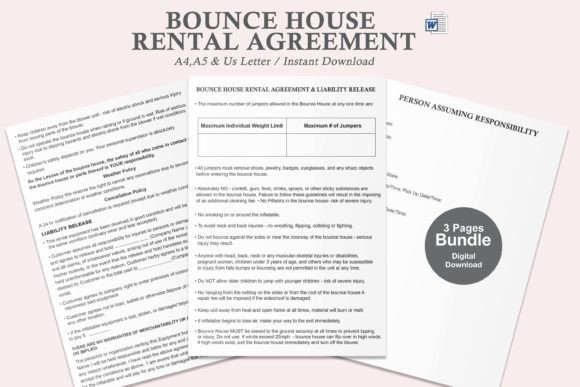
A more effective strategy is to make the waiver a separate, clearly labeled section within the bounce house rental agreement. Use straightforward sentences: “I acknowledge that I am responsible for supervising all children and ensuring the bounce house is not overloaded or used during high winds.” Then include a brief checklist that the renter initials next to key points—like understanding the maximum number of jumpers by age group. This creates a paper trail showing they were specifically made aware, not just that they signed at the bottom of ten pages.
When Party Rental Terms Leave Insurance Gaps Open
Both equipment owners and the families renting need to understand how insurance fits into the picture. Too many operators assume a general business liability policy covers them automatically, only to find after an injury that inflatables are excluded unless specifically listed. Similarly, many homeowners believe their personal umbrella policy will cover a rented bounce house accident, but backyard amusement equipment often falls outside standard coverage.
A well-prepared bounce house rental agreement addresses this directly. It should state whether the rental company carries its own liability insurance and what that policy actually covers. If not, the contract must be transparent about that, placing the responsibility on the renter to verify their own coverage. For owners, having proof of insurance attached as an addendum to the party rental contract does more than just look professional—it reassures parents and reduces last-minute hesitations. For renters, never assume the rental company’s policy protects you from every scenario; ask to see the details and check if it covers property damage if the unit damages your irrigation system or landscaping.
Weather Policies That Protect Instead of Provoke Arguments
A vague line reading “no refunds due to weather” is one of the fastest ways to generate negative reviews and chargebacks. It’s also a frequent source of confusion. A bounce house rental agreement needs to define what constitutes unsafe weather and what happens next. Does rain mean a full refund, a credit for a future date, or simply a cancellation of delivery with no money back? What about strong winds that arrive mid-party—does the renter get a partial refund if the unit must be deflated for safety? Spelling this out in the inflatable rental contract prevents late-night angry calls and public social media complaints.
One approach that works well for many small operators is to offer a rain-check policy where the booking is moved to a mutually agreed-upon future date without penalty, as long as the decision is made by a certain cutoff time (like two hours before delivery). For truly unworkable conditions like thunderstorms or wind gusts exceeding the manufacturer’s limit, the agreement should state that the rental company reserves the right to cancel delivery for safety with a full refund. That small clause builds enormous trust.
Overlooking Setup Safety and Inspection Steps
Even the most detailed bounce house rental form is useless if the equipment arrives in unsafe condition or is set up incorrectly. Yet many rental owners rely on verbal instructions or a quick final walkthrough that leaves no record. The agreement should either require or incorporate a simple pre-use inspection and setup checklist. This might include verifying anchors are properly driven into the ground, checking the blower for damage, confirming that the unit is fully inflated with no sagging, and ensuring that no sharp objects are nearby.
For renters, this is your chance to document the condition of the inflatable before the first child jumps inside. Use your phone to take a quick video or photos that show the cleanliness and integrity of the bounce house. If there’s a pre-existing tear or a patch that wasn’t disclosed, note it on the event equipment agreement before the attendant leaves. That small habit sidesteps false damage claims. For owners, having a signed inspection sheet attached to the main rental agreement helps prove the equipment was delivered in proper working order—protecting you from a renter who might later blame you for an accident they caused by ignoring rules.
Thinking a Digital Signature Solves Everything
Going paperless is convenient, but a hastily clicked “I agree” box on a website doesn't automatically create a solid legal trail. Some bounce house rental businesses rely on a simple online booking form that bundles the contract, waiver, and payment page together, which can bury critical terms below the “Book Now” button. If a dispute escalates, showing that someone scrolled through and actively engaged with each section matters more than a single timestamp.
Whether you use a PDF bounce house rental agreement, an editable Word file, or a digital signing platform, design the sign-off process so that key terms can’t be skipped. For instance, include a separate checkmark that says “I have read and understand the supervision requirements” and “I accept that adult supervision is mandatory at all times.” If you’re a renter, never click through without reading these points, even if the design tries to rush you. A legitimate provider won’t mind you taking five extra minutes to review the party rental contract before committing.
Forgetting That Different Events Need Different Terms
A bounce house at a quiet residential birthday party and one at a large church festival or school fair involve very different risk profiles. Yet many inflatable rental businesses reuse the exact same document for every booking, which results in an agreement that is either too strict for a small gathering or dangerously permissive for a crowded public event. The number of attendees, the presence of unsupervised older kids, and whether food and drinks are allowed nearby all change the safety dynamic.
Customize the bounce house rental agreement for each type of event. For a backyard party with young children, the contract might emphasize that an adult must remain within sight of the unit at all times and that no flips or roughhousing are allowed. For a community event, it might add a requirement that the renter provides at least one designated volunteer to monitor the entrance continuously and that the bounce house must be deflated and secured during any scheduled breaks. A template with editable fields makes this easy—just adjust the party rental terms to match the reality, then save the version as a reusable baseline.
What to Check Before You Sign as a Renter
- Look for explicit cancellation and refund timelines. If the agreement says you can cancel 48 hours before the event for a full refund, confirm whether that includes weekends and holidays. Some contracts count only business days, which can trap you.
- Verify damage responsibility. A fair event rental agreement will define what constitutes normal wear versus negligent damage. If the contract says you’re liable for “any damage whatsoever,” that’s a red flag.
- Confirm delivery window and setup time. A bounce house that arrives at 4 PM for a 4 PM party start means children are waiting while the team inflates. The agreement should specify a window that gives you at least 30 minutes before your event begins.
- Check whether the price includes stakes, sandbags, and blower. Some party rental contracts quote a low price but tack on essential accessories as add-ons. A complete bounce house rental form itemizes exactly what’s included.
What to Double-Check as a Rental Business Owner
- Does your liability waiver hold up in your state? If you operate across state lines, have a legal professional review whether your waiver language meets local standards for exculpatory clauses. One poorly worded section can wipe out the protection you thought you had.
- Are your contact details and emergency procedures easy to find? If a renter needs to reach you because a child got hurt or the unit starts deflating unexpectedly, they shouldn’t have to search through ten paragraphs. Place your phone number and a brief emergency shutdown instruction prominently within the bounce house rental agreement.
- Do you have documentation that the renter received safety rules? Whether it’s a separate one-page sheet they sign or an embedded section of the contract, keep evidence that they were explicitly given the rules—not just a link to a video they might not watch.
A thoughtfully prepared bounce house rental agreement isn’t about creating intimidating paperwork. It’s about setting clear expectations, reducing last-minute panic, and letting both sides enjoy the event without second-guessing what happens if something goes wrong. When you treat your inflatable rental contract as a living document that you update based on real-world experience, each booking becomes smoother than the last. The moments you invest in clarifying terms, explaining coverage, and requiring inspection documentation are exactly what prevent minor misunderstandings from escalating into major headaches.
As you review your own party rental terms—whether you’re printing an editable bounce house rental form for this weekend’s delivery or choosing a template to standardize your whole season—focus on clarity over length. A six-page document no one reads delivers less protection than two pages of well-organized, honest language that people actually understand. Use checkboxes, separate waivers, and visual cues to make the important parts stand out. That adjustments builds confidence, reflects professionalism, and, most importantly, keeps children safe while they bounce.