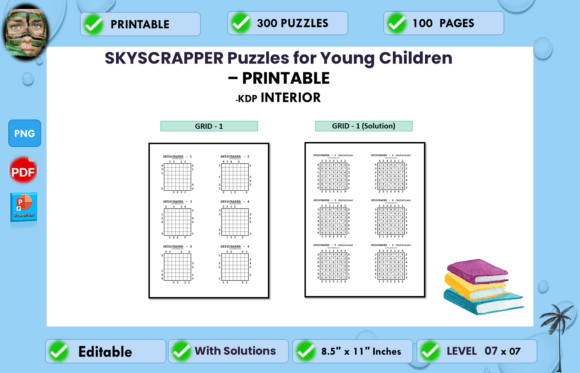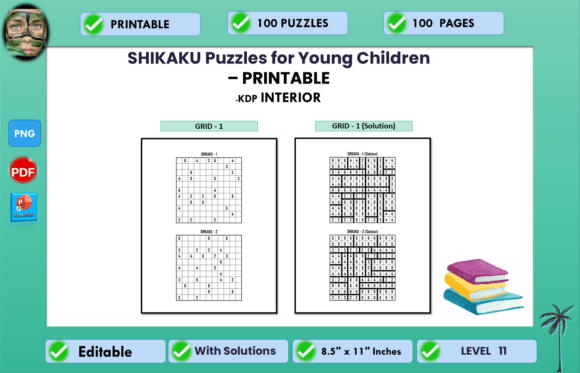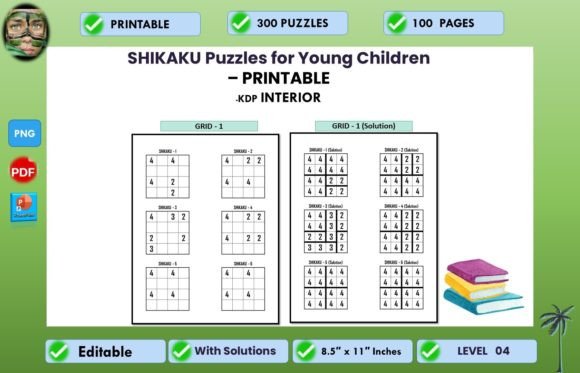
SKYSCRAPPER Puzzles for Young Children 5
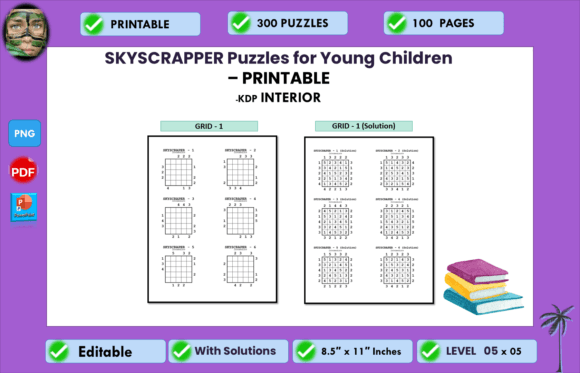
Picture a puzzle that blends logic, visual scanning, and a gentle rush of accomplishment — all on a grid that looks like a tiny city skyline. That is the magic of SKYSCRAPPER puzzles, and when adapted for young children, they become one of the most engaging, screen-free brain builders you can offer. This particular product is not just a puzzle book; it is a carefully formatted KDP interior, ready to upload to Amazon and start selling as your own low-content creation. With 100 fully tested and formatted pages, you receive a print-ready PDF that demands zero design time. Whether you are a stay-at-home parent looking to build a passive income stream, a teacher who wants custom puzzle workbooks, or a hobbyist exploring the world of self-publishing, this interior can become your shortcut to a polished, marketable product.
SKYSCRAPPER puzzles, sometimes called "building" or "city view" puzzles, present a grid and a set of clues around the edges. The goal is to fill in numbers that represent the heights of buildings, making sure that each row and column follows specific visibility rules. For young children, the grids are simpler — often 4x4 or 5x5 — using only numbers 1 through 4 or 5. The result feels less like a math drill and more like a detective game. Children learn to think step by step, test possibilities, and build confidence without ever sensing they are doing "work." The interior you are looking at here is specifically designed for the five-year-old brain, with clear instructions, large grids, and a gradual progression that keeps frustration low.
What Makes This Interior a Smart Choice for KDP Publishers
Low-content publishing thrives on simplicity, but simplicity done right requires precision. This interior isn’t a generic template thrown together. It has been formatted to meet Amazon KDP’s exacting print standards: 8.5 x 11 inches, no bleed, high-resolution graphics that print sharp even on standard paper. Every page is tested, meaning you won’t discover odd margins, blurry numbers, or misaligned solutions after you’ve already ordered a proof copy. The set includes 100 pages of puzzles plus solutions, which is the sweet spot for a children’s activity book — substantial enough to feel like good value, yet short enough to keep production costs low. The files come in PDF, PPT, and PNG formats, giving you flexibility whether you want to upload directly, tweak a few branding elements, or use an online editor.
Because this is an interior-only product, you are responsible for creating your own cover. That’s actually a benefit. You can design a cover that speaks to a specific niche — maybe bright, playful animals pointing at skyscrapers, or travel-themed with vintage suitcases stacked like buildings. You keep full creative control over the book’s market positioning. And when you realize how many parents search for “travel games for kids,” “logic puzzles age 5,” or “screen-free activities,” you’ll see why a sharp cover can make all the difference. The interior does the heavy lifting; you just wrap it in a concept that clicks with your ideal buyer.
Creative Formats and Niche Spins
While the interior works beautifully as a standalone puzzle book, you aren’t limited to a plain “Volume 1” approach. Think like a product designer. You could bundle this interior with other puzzle types — mazes, spot-the-difference, word searches for early readers — and create a mega activity book. Because the SKYSCRAPPER puzzles target spatial reasoning, they pair exceptionally well with tangram challenges or simple block-building exercises. An educator might take the PDF and pull individual pages to use as warm-up sheets in a kindergarten classroom, laminating them for wipe-clean math centers. A family blogger could use the PNG files to create a free printable sampler, building an email list by offering five puzzle pages in exchange for a subscription.
Consider seasonal packaging. A “Summer Road Trip Brain Boosters” cover with the same interior suddenly speaks to a whole new set of parents planning vacations. Or a “Quiet Time Activity Book for Church and Restaurants” edition focuses on the calm, focused nature of the puzzles. The internal content remains unchanged, but your cover and product description angle do the selling. This is how savvy KDP users stretch a single interior into multiple income streams without touching a single puzzle grid.
Using the Interior Beyond KDP
Your purchase isn’t locked to Amazon. The high-resolution files can serve as master pages for printed workbooks sold on Etsy, Shopify, or at local teacher supply stores. If you run an early learning center, you can print the pages as needed for your own students — no recurring licensing fees, no counting copies. The PPT format allows you to slightly resize or rearrange pages, which is useful if you want to create a smaller format book, like 6x9 inches, for a travel series. Because the designs use clean black-and-white line art, they print beautifully on any home printer, and parents love that they don’t drain color ink. You can even adapt a few puzzles into digital slides for interactive whiteboard use, though the complete interior shines brightest as a tangible print experience.
A practical, often overlooked approach: use the interior as a lead magnet for a tutoring service. Give away a 10-page mini-book with your contact details on the back. Parents of five-year-olds are actively looking for ways to support early math and logic skills, and a high-quality puzzle sample positions you as an expert who understands child development. The puzzles themselves act as a gentle assessment tool — watching how a child approaches the grid gives you insight into their reasoning skills, frustration tolerance, and pattern recognition.
Practical Upload and Formatting Tips
Because the PDF is already sized at 8.5x11 inches with no bleed, uploading to KDP is straightforward. In your KDP dashboard, select “Paperback” or “Hardcover” (many children’s activity books sell better in paperback), choose “Black & White Interior with White Paper,” and set the trim size to 8.5x11. Do not let KDP resize the file. The interior is calibrated for that exact dimension, and any scaling can distort the puzzle grids. When you upload, you’ll get a digital previewer to check that the margins stay consistent. Since no bleed exists, you avoid the common headache of text or important graphics getting trimmed during printing.
After uploading the interior, you’ll need to create your cover. Use KDP’s cover calculator to determine the spine width (it will depend on your page count). Then design a wrap-around cover in a program like Canva or Photoshop, keeping any critical text within the safe zone. Your cover doesn’t have to be a masterpiece — a clean, colorful design with large, easy-to-read title text often outperforms busy compositions. Remember to mention “Skyscraper Puzzles for Ages 4-6” clearly on the front, and consider adding a small callout like “100 Fun Logic Puzzles with Answers” to boost click-through. Once everything is submitted, order a proof copy. Flip through every page, check that solutions appear where expected, and feel the paper quality. One thoughtful test order saves you from a flood of returns later.
How Different Users Find Value
Let’s look at three realistic scenarios that move beyond theory. First, a freelance graphic designer who already sells party invitations on Etsy wants to add a passive product. She downloads the interior, designs a cute “My First Puzzle Book” cover with hand-drawn letters, and lists it within two days. She doesn’t love puzzles; she loves the extra monthly income without client demands. Second, a grandparent who crafts custom activity books for grandchildren uses the interior to create a one-of-a-kind birthday gift. He prints the PDF at a local print shop, adds a personalized dedication page, and hands over a spiral-bound book that no store carries. Third, a homeschool mom who blogs about her minimalist curriculum purchases the interior, prints a few pages each week, and shares photos on Instagram. Her followers start asking where to buy the book, so she sets up a quick KDP listing using the same interior, adds her blog’s branding to a simple cover, and essentially pre-sells to an existing audience.
What ties these scenarios together is the removal of the hardest part of puzzle creation: formatting and testing. You inherit 100 puzzles that have been solved and verified. The solutions are included, which means you won’t need to painstakingly solve every grid yourself to check accuracy. For young children, a wrong answer key can destroy trust in a product, so having reliable solutions is more than a convenience — it’s a quality control measure that protects your reputation.
Blending Puzzles Into a Larger Toolkit
One of the most satisfying developments in early childhood learning is the move toward integrated skill-building. Skyscraper puzzles don’t just sit in a logic box. They quietly reinforce number recognition, directional vocabulary (up, down, left, right), and persistence. You can build a themed bundle that includes these puzzles alongside simple sudoku, mazes, and even coloring elements. If you already sell a coloring book for kids, consider adding a “Bonus Logic Challenge” section with 10 skyscraper grids. This cross-sell exposes existing customers to a new format, and the interior you purchase gives you hundreds of extra puzzles to draw from for years.
Another path is to focus on the bilingual market. The visual nature of skyscraper puzzles means they require very little text. A smart publisher might translate the instruction page into Spanish, French, or German, use the exact same puzzle interior, and tap into a less saturated category. KDP allows you to list the same interior under multiple language settings as long as the cover and metadata are appropriate. This isn’t a loophole — it’s simply recognizing that a logic puzzle’s value is universal.
When you sit down to plan your next low-content product, think about the moment a parent or teacher discovers your book. They’re tired, maybe looking at a screen at 10 p.m., hoping to find something that will keep a five-year-old happily occupied on a plane or during a rainy afternoon. They see your cover, read your description, and they want to believe the promise. The interior you use has to deliver. This one does. The puzzles feel fresh but achievable. The formatting keeps the visual noise low, so young eyes can lock onto the challenge without distraction. The solutions give a quick satisfaction check. Every detail speaks to the experience of a child who is just beginning to love figuring things out.
You don’t need a background in puzzle design. You don’t need to understand the mathematical underpinnings of Latin squares or combinatorics. You need a high-quality core asset and the willingness to present it in a way that feels personal and intentional. Pair this interior with a thoughtful cover, write a description that signals empathy (“Frustration-free fun for five-year-olds”), choose the right keywords, and let the print-ready pages do what they were built to do — challenge, delight, and sell.