Mine Finder Puzzle Book for KDP Part 08: Smart Publishing Without the Pitfalls
You’ve probably seen the promise: a ready-to-go PDF interior, a matching cover, and a keyword spreadsheet all bundled up, ready to upload to Kindle Direct Publishing. The Mine Finder Puzzle Book for KDP Part 08 package sounds like a straightforward shortcut to creating a logic puzzle book. And for many self-publishers, it really can work—but only if you understand exactly what you’re getting and avoid the small, quiet mistakes that turn a promising product into a returns magnet.
This isn’t yet another rave review. Instead, we’ll walk through what this specific puzzle book interior actually contains, where people misinterpret what they buy, and how a few practical checks before you hit “publish” can save you from wasted ad spend, negative reviews, and reformatting headaches. I’ll keep it useful and balanced, because your time and your launch credibility matter.
What You’re Really Looking at in the Mine Finder Puzzle Book for KDP Part 08
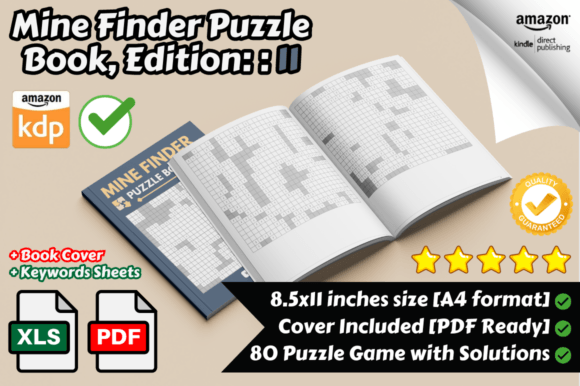
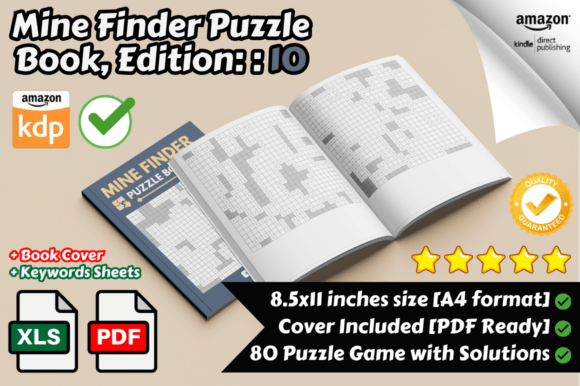
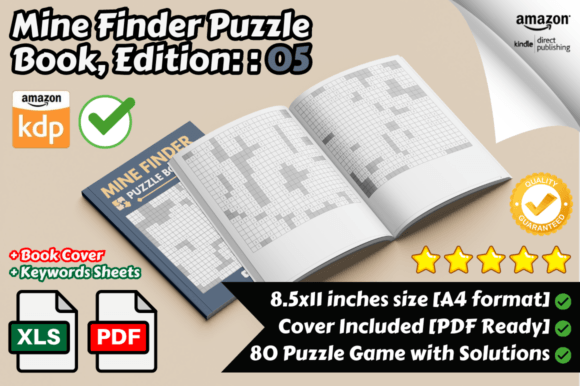
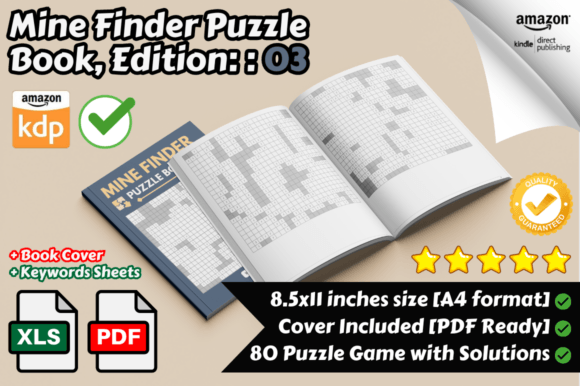
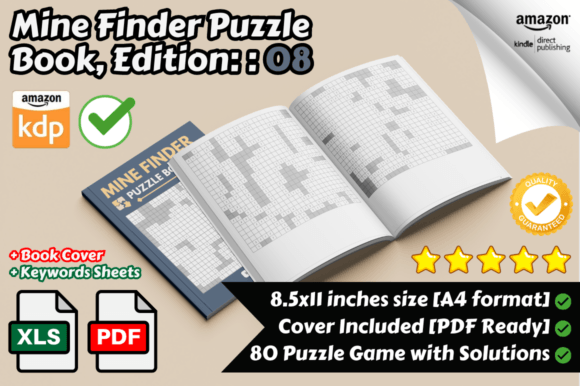
Let’s strip away the marketing language. The core product is a PDF interior file—160 pages in an 8.5×11 inch trim size. Half of those pages (80) are the actual mine finder puzzles, and the other 80 pages hold the solutions. That’s a thoughtful split; many puzzle book creators cram solutions into tiny text at the back or omit them entirely, which frustrates buyers. Alongside that, you get a separate PDF cover file and an Excel spreadsheet filled with suggested keywords. The concept is to give you a plug-and-play experience for KDP.
The puzzles themselves are grid-based logic challenges—think a hybrid of Minesweeper and Sudoku—where you deduce the location of hidden mines using numeric clues. They appeal to adults who enjoy brainteasers, slow-thinking hobbies, and screen-free mental workouts. If you’re targeting the 20–50 age bracket, that’s exactly the kind of audience searching for “logic puzzle books for adults” or “mind-bending puzzles” on Amazon.
But here’s where the surface-level convenience masks a few critical details. The product’s description mentions boosting brainpower and enhancing problem-solving skills. That’s accurate, but it also creates an implicit expectation: the interior must look polished, the puzzles must be error-free, and the solutions must be undeniably correct. If any of those fail, you’ve lost trust, and with it, your Amazon seller rating.
Mistake #1: Assuming the Interior PDF Is Print-Ready for Your Specific Needs
The most common oversight I see with puzzle book interiors—whether the Mine Finder Puzzle Book for KDP Part 08 or any other template—is treating the PDF as a one-click solution. Yes, it’s designed for 8.5×11 inches, but KDP’s trim size options sometimes include 8.5×11 with or without bleed. If the interior file wasn’t built with bleed in mind and you select a bleed setting during upload, Amazon’s system may flag the file. Conversely, if you need bleed but the PDF margins are too tight, content could be trimmed off unpredictably.
What to do instead: Before uploading, open the PDF in a viewer that shows trim boxes (like Adobe Acrobat’s Print Production tools). Check if there’s at least 0.125 inches of extra margin beyond the content for all sides if bleed is required. If unsure, export a test page as a flattened image and overlay a KDP template from their website. This takes ten minutes and prevents the dreaded “interior mutilations” review comment.
Another overlooked detail: font embedding. If the interior uses custom fonts for puzzle numbers or instructions and they aren’t fully embedded, KDP’s print engine might substitute them, causing alignment issues. Verify font embedding in the document properties. If everything is outlined or standard, you’re safe.
Mistake #2: Relying Too Heavily on the Provided Excel Keyword Spreadsheet
The inclusion of an Excel file with “powerful keywords” sounds like a goldmine for discoverability. However, keyword spreadsheets in KDP puzzle book bundles are often generalized. They might list terms like mine finder puzzles, brain teasers for adults, logic puzzle books, but they’re not tailored to your specific book’s unique angle. If you simply copy and paste those keywords into your Amazon backend, you’re competing with every other seller who bought the same bundle. Worse, you might be using high-volume terms that have little actual buyer intent for a physical puzzle book.
A more effective approach: Treat the spreadsheet as a starting point, not a finished asset. Go to Amazon, type those keywords into the search bar, and observe the autocomplete suggestions. Look at the first page of results: are they all similar puzzle books, or are you up against video games and apps? Then, refine your keywords to include long-tail phrases like “large print mine sweeper puzzle book” or “adult logic puzzles with solutions on facing page.” Use the back-end keyword fields to weave in what buyers actually type, not just what a category list suggests.
Also, remember that your book’s title and subtitle have far more ranking power than hidden keywords. If the bundle includes a suggested title, personalize it. Instead of a generic “Mine Finder Puzzle Book,” consider “Mine Finder Puzzles for Relaxation: 80 Grid-Based Brain Teasers with Step-by-Step Solutions.” That immediately differentiates you and speaks directly to the relaxation-oriented buyer.
Mistake #3: Neglecting the Cover’s KDP Compliance
A professionally designed PDF cover is a genuine time-saver. But if you don’t adjust the spine width based on your exact page count and paper choice, the cover will misalign. The Mine Finder Puzzle Book for KDP Part 08 interior has 160 pages. If you’re printing on white paper, that’s a specific spine width (roughly 0.34 inches for cream paper, slightly less for white). KDP’s cover creator will auto-generate a template once you enter your page count—use it. Don’t assume the cover file provided matches that exact calculation, especially if the bundle was originally created for a different printing setup.
Another subtle mistake: the barcode area. The cover PDF must leave space for Amazon’s barcode. If your design places important text or puzzle elements there, they’ll be obscured. Open the cover file, overlay a KDP template, and ensure no critical graphics are in the lower right quadrant of the back cover. This sounds mundane, but I’ve seen beautiful covers rejected for a missing barcode clearance.
Even the spine text readability matters. If the spine width is too narrow for the title, the text may wrap or become illegible. Given 160 pages, the spine is slender, so keep spine text minimal—maybe just “Mine Finder” and a small logo. If the provided cover crams too many words, simplify it before uploading.
Mistake #4: Assuming All 80 Puzzles and Solutions Are Error-Free
Puzzle book creators, even meticulous ones, can overlook a solution mismatch or a misnumbered clue. When you’re not the original puzzle designer, you’re placing your trust in someone else’s quality control. This is particularly risky for logic puzzles like mine finder, where a single wrong number can make a puzzle unsolvable—or solvable in a way that contradicts the official solution. Those one-star reviews that say “puzzle 34 has no valid solution” can sink a new book’s momentum.
Practical due diligence: You don’t need to solve all 80 puzzles yourself. Randomly sample at least ten across different sections. Solve them by hand or use a digital grid to verify that the solution page matches. Also test the difficulty ramp: do early puzzles gently introduce the mechanics, or are they thrown in cold? If the first puzzle is too hard, you’ll alienate beginners. You can reorder pages in the PDF before uploading—Amazon doesn’t check puzzle difficulty sequencing, but customers definitely notice. Consider adding a brief “How to Play” page if the interior lacks one. A single-page rules summary drastically reduces confusion and negative reviews.
Mistake #5: Overlooking the Book’s Long-Term Usability
The 8.5×11 format is popular, but it’s worth thinking about the physical experience. A large puzzle book can be awkward for sofa solving. Some buyers prefer a more portable size. Now, you can’t change the interior’s trim without a major redesign, but you can manage expectations. If the bundle markets itself as “for all ages,” be mindful that the grid size might be too small for seniors or those with visual strain. Check that the numbers in the puzzle cells are large enough. If they’re on the smaller side, add a note in your description like “large-print puzzles” (if true) or “clear, easy-to-read grids.” Honesty reduces returns.
Also consider spiral-bound preferences. KDP doesn’t offer spiral binding, but you can note that the book lays flat if used with a bookstand. Little details like that demonstrate reader empathy and set you apart.
A Better Way to Launch: Your Pre-Upload Checklist
Instead of firing off the files immediately, run through this quick list:
- Inspect the interior PDF for trim size, margins, and bleed settings against your KDP specifications.
- Verify font embedding or outline all text to avoid substitutions.
- Randomly test 10–15 puzzles for solution accuracy and check the first five for progressive difficulty.
- Add a brief “How to Solve” guide if absent, using simple language and a worked example.
- Customize the cover template using KDP’s cover calculator, adjusting spine text and barcode clearance.
- Refine keywords by combining bundle suggestions with your own Amazon search bar research and competitor title analysis.
- Write a description that mentions specific benefits like “solutions on separate pages” and “screen-free brain training for adults.”
- Order a proof copy and physically check print quality, puzzle clarity, and cover alignment before making it live.
When This Bundle Makes Sense
Despite the caution points, the Mine Finder Puzzle Book for KDP Part 08 can be a solid foundation if you treat it as a starting framework rather than a finished product. It’s ideal for creators who understand basic KDP formatting, want to avoid designing grids from scratch, and are willing to invest a few hours in personalization and validation. For hobbyists, small business owners dipping their toes into low-content publishing, or bloggers expanding into print products, this bundle cuts down graphic design time significantly.
But if you’re expecting a zero-effort bestseller, it’s better to recalibrate. The puzzle book niche is saturated, but quality and attention to detail still win. The bundle gives you the puzzle mechanics and layout—your job is to make the book feel trustworthy and unique.
The Real Value No One Talks About
Beyond the files, the most underleveraged part of this bundle is the experience you can build around it. Mine finder puzzles have a cult following among puzzle solvers who enjoy deductive reasoning and the thrill of uncovering hidden patterns. Your listing can include a note about the mental health benefits: calming logic exercises, mindfulness through focused solving, and a screen-free evening ritual. That’s the kind of messaging that the generic Excel keywords won’t deliver for you.
Also, think about series potential. Part 08 implies earlier volumes. Even if you only have this one, you can structure your branding to suggest a collection, encouraging repeat purchases. A small “Look for more titles” page at the end links to your author page—simple but effective.
Above all, remember that every puzzle book interior is just blueprints. The finished house is what you present to the buyer. By catching errors early, adapting the packaging to your audience, and refusing to assume that “ready-to-use” means “perfect as-is,” you transform a bundle into a product you’re proud to sell. And in the world of KDP, that’s the difference between a forgotten flop and a slow-burn passive income stream that earns genuine, organic reviews.